
Hiding is how many of us learned to survive.
Unhiding is how we learn to thrive without doing it all alone.
Recently, a friend told me about the anxiety they felt around hosting people for the holidays. Not panic. Not drama. Just the constant mental math. Is it enough? Is it too much? Will I disappoint people? They’d been carrying that stress quietly for a long time.
When they finally said it out loud to one trusted person, something shifted. The anxiety did not magically disappear. But the weight did. And that other person showed up in ways they didn’t expect.
That moment may seem small. It isn’t. It’s a disruption of how we’ve been taught to hide.
Because most of us were taught to manage challenges privately, competently, and without burdening anyone else. Inviting someone in interrupts that pattern. That’s the power of inviting one person in.
What Invite In Really Means
Last month, we started with Step 1: Acknowledge.Noticing what you are hiding. Naming it.
This 2nd step is about what comes next. Because unhiding was never meant to be done alone, especially in the workplace.
Somewhere along the way, many of us learned that needing support signals weakness. And that competence means handling everything on our own. So we push through. Manage it. Keep the professional mask in place.
That leadership model is familiar. It’s also costly. It breaks trust, connection, and performance.
Inviting one person in is a quiet disruption of that model.
Unhiding doesn’t mean oversharing. It means choosing one person and sharing one honest thing with them.
“I have been struggling.” “I do not have this figured out.”
Just one person.
And chances are, someone already came to mind. Your go-to person. (Who is it for you?)
The Cheat Sheet
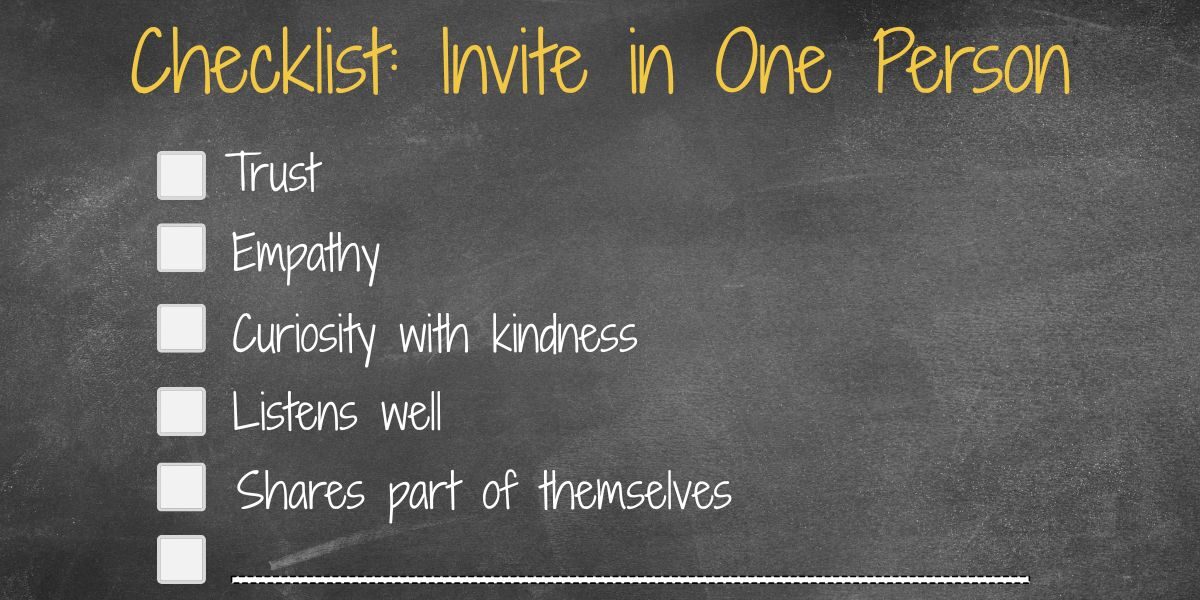
When you are deciding who to invite in, look for someone who:
- Asks questions with curiosity, not judgment
- Responds with kindness and empathy
- Is willing to share something about themselves
This step is not about being fixed. It is about being seen. And being seen is foundational to trust at work.
One Important Thing to Remember
You may have been living with the thing you are sharing for a long time. The other person may be hearing it for the first time.
If they pause, that does not mean rejection. It usually means they are trying to understand.
And if someone dismisses you or minimizes what you share, that is not a failure. It is information: they are not your person.
Unhiding is a choice. You decide what to share, whom to share it with, and when.
The Impact of Not Doing It Alone
There is real relief in unhiding with one person. Your shoulders drop. Your breath changes. You can exhale.
That relief isn’t just emotional. It’s cognitive. When we stop carrying something alone, we think more clearly, build trust more easily, and show up with greater capacity.
That is why this step matters.
A Note for Leaders
If you are a leader, this is both personal and professional.
Who do you invite in when things are hard? And what are you teaching your team by how you answer that question?
Workplace culture doesn’t change through policy alone. It changes when people see a different way to operate under pressure.
People bring their best selves to work when they see it’s safe to do so. Because it was modeled.
A Gentle Invitation
Who is the one person you could invite in this month?
You do not need a perfect script. Just one honest sentence. “Can I share something I’ve been holding quietly?” Or, “I’m not looking for advice. I just need someone to hear me.”
That is how connection begins. And that’s how human-centered disruption starts.
When you try it and want to tell me how it went, I’d love to hear. And happy holidays!
Warmest, Ruth
P.S. Next month, we move to Step 3: Building Community.
Thank you for being part of the UNHIDING community.
|

