
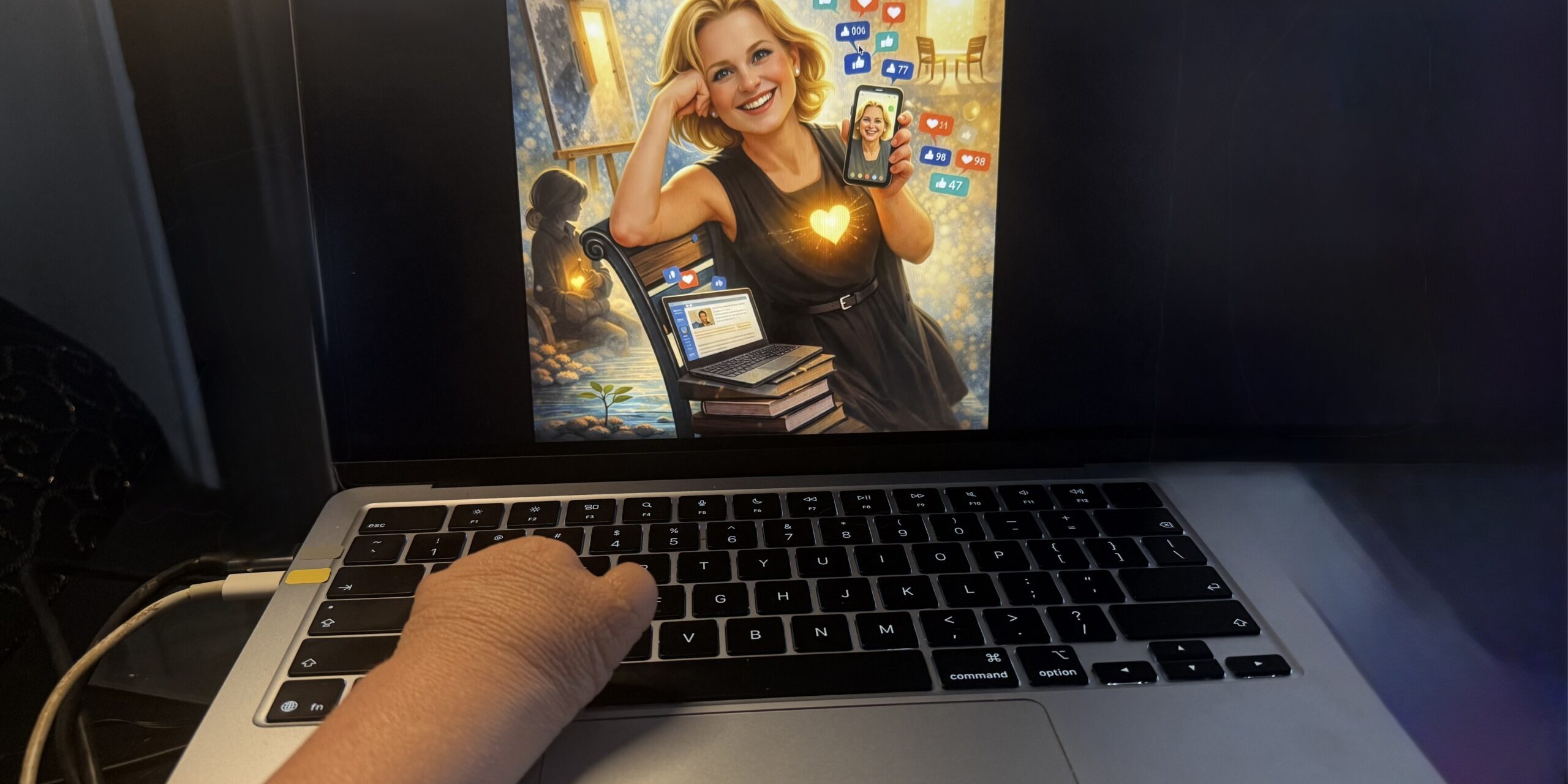
I asked AI to generate a picture of me based on what it knew about me.
The words were correct.
The image was not.
It gave me two complete hands.
The problem is, I only have one.
I went back and attached an actual photo of my hand. My little hand. The hand I spent twenty-five years hiding in my pocket before I finally stopped.
So I tried again.
This time, it gave me a short, blunt nub above my elbow.
Closer.
But still not mine.
And definitely not the hand in the photograph I had just given it.
And here’s what I did next.
I wrote a post about it.
Then I closed the app and thought, That’s it. I’m done.
And then something about that started to bother me.
For twenty-five years, I tried to make my hand look like everyone else’s.
Now AI was doing it too.
But the part I keep thinking about isn’t just that AI got my hand wrong.
It’s that when it did, I stopped asking to be seen accurately.
That moment stayed with me.
Productivity. Creativity. Trust. Jobs. Misinformation.
Those are the questions everyone seems to be asking about AI.
Mine was different.
Not what AI is becoming.
What it’s revealing about us.
I recently coached someone whose manager expected them to know things they hadn’t yet been taught.
They didn’t know how to do it, so instead of saying, “I don’t know how to do this yet. I need some help,” they quietly started using AI to produce the reports themselves.
And it worked.
The reports got done.
The manager saw a capable employee producing good work.
But the employee never learned the skill.
And the manager never learned they needed help.
No awkward conversation.
No admitting they didn’t know.
No risk of looking incompetent.
AI became the safer place to struggle.
And that’s what worries me.
Research this year found that nearly four in ten employees say they’re asking their managers fewer questions because it’s easier to ask AI instead. More than a quarter worry that asking for help will make other people question their competence.
People don’t feel safe enough to ask for help.
And that’s where this stops being an AI story and becomes a leadership story.
The Hidden Struggle
This isn’t just a skills problem.
It’s a visibility problem.
Most leaders see AI as a productivity tool.
It often is.
But it can also make it much harder to see where people are struggling and need support.
On the surface, everything looks fine.
We celebrate the work getting done while missing the human being doing it.
That’s where leaders lose visibility.
People have always hidden.
Some by staying quiet.
Some by overachieving.
Some by becoming the person who always has the answer.
AI didn’t invent hiding.
It makes hiding easier to miss.
It hides the need for help behind competence.
The report shows up on time.
The manager sees competence.
The need for help stays hidden.
If AI becomes the safer place to say “I don’t know,” what does that mean for the relationship between a leader and their people?
I don’t think the answer is that we need leaders less.
I think we need them differently.
We spend a lot of time asking whether AI can become more human.
Maybe the more important question is whether we’re still willing to be human with each other.
To say, I don’t know.
To ask for help.
To show what’s different.
To risk being known.
That’s unhiding.
AI gives us an extraordinary new tool.
But it also gives us an extraordinarily easy new place to hide.
It didn’t create hiding.
It simply revealed where it still exists.
One Thing to Try This Week
If you manage people, don’t ask your team,
“What are you telling AI that you’re afraid to tell me?”
Please don’t.
If they don’t already feel safe with you, you’ve just made your next one-on-one even more uncomfortable.
Go first instead.
Before your next one-on-one, share one true, specific thing you didn’t know, needed help with, or got wrong recently.
Not a performance of humility.
An actual thing.
You’re not asking anyone else to confess.
You’re showing them, just once, that not knowing something doesn’t end badly in the room you’re in charge of.
I’m realizing I may have some work to do here too.
I still haven’t told the company that its tool couldn’t draw my hand.
I have plenty of reasonable stories I can tell myself.
I’m busy. It’s not a priority. I’m not particularly upset about it.
All of those things may be true.
But I also know what hiding sounds like when it disguises itself as something reasonable.
Before I go, two questions I’m asking myself:
Where am I choosing the easier place to hide instead of the harder place to be known?
What are your people telling AI because they don’t yet feel safe enough to tell you?
AI can process an enormous amount of information.
But being processed isn’t the same as being known.
I hope we never forget the difference.
Warmest, Ruth
P.S. If your organization is investing in AI, don’t forget to invest in the people using it. That’s where I work with leaders to build trust, psychological safety, and cultures where people feel safe asking questions, speaking up, and bringing their best selves to work.
Thank you for being part of the UNHIDING community.
|

