
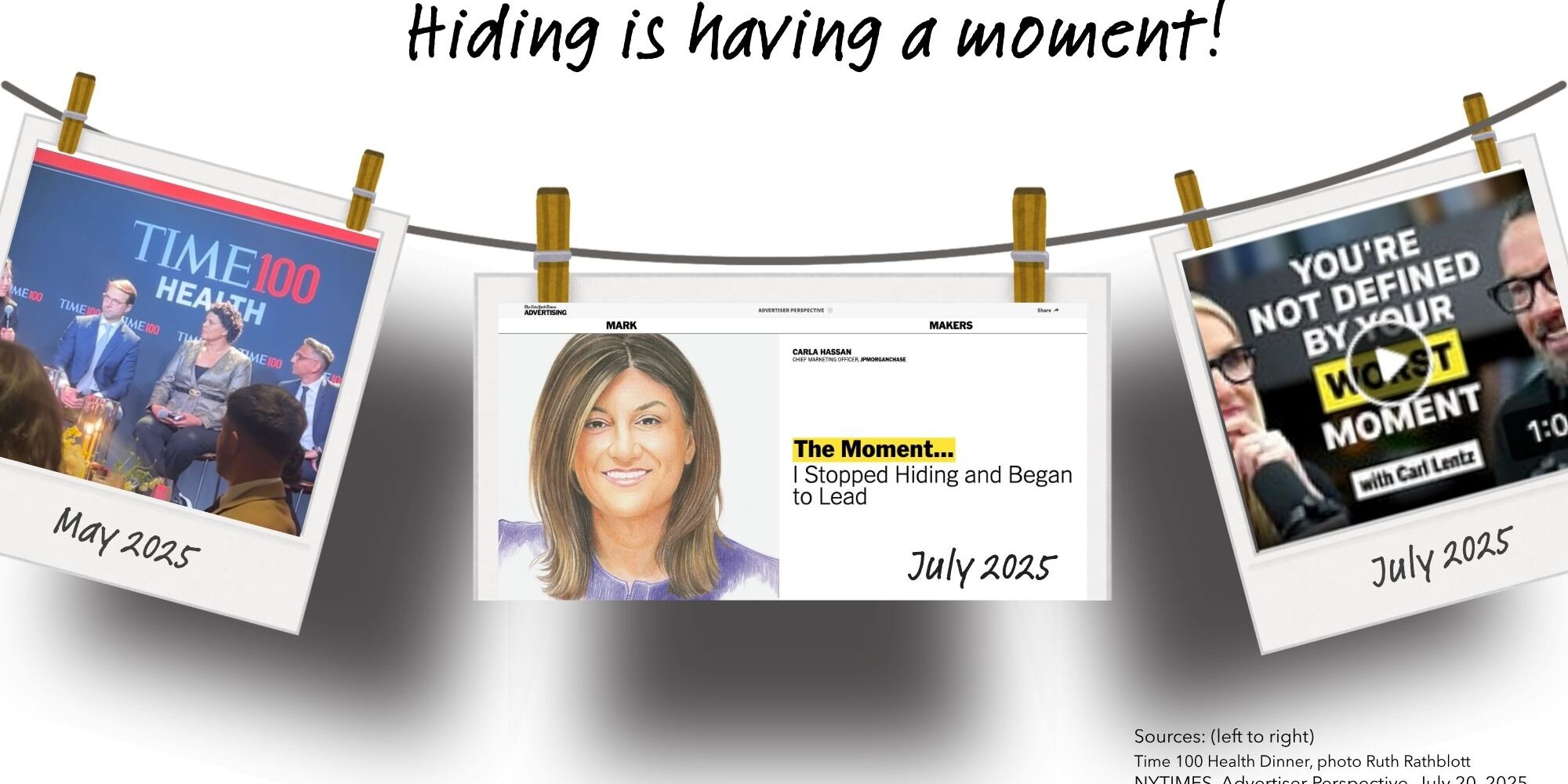
Lately, I’ve been noticing hiding everywhere, at a dinner with TIME, splashed across a full-page ad in The New York Times, and in a candid conversation on Mel Robbins’ podcast.
You’ve been spotting it too, sending me articles, podcasts, and movie scenes (keep them coming).
Hiding—and unhiding—are everywhere. Once you start noticing it, you can’t unsee it.
1. When the Instinct Is to Hide
At the TIME100 Health Impact Dinner in May, CNN’s Sara Sidner shared her cancer diagnosis with striking honesty, especially between the :51 and 3:52 mark.
Her first instinct? Hide—from friends, her employer, even family.
Afraid she’d lose her job. Afraid she’d be seen as dying. Afraid others would see her as “less than.”
But when she learned it was stage three, hiding wasn’t an option.
“Eventually, I realized I had to tell people. I needed to be really honest—sometimes disturbingly honest—about what I was going through.”
Insight: Hiding hard truths blocks the support, resources, and flexibility we need at every level. When leaders model honesty, they signal that others can, too.
2. What Hiding Might Be Costing You
On Mel Robbins’ podcast, Carl Lentz, former lead pastor of Hillsong Church, whose career ended due to “leadership failures and breaches of trust,” spoke about the toll of hiding and the relief and freedom of finally telling the truth:
“Whatever you’re hiding is taking the place of what could be power.”
Hiding feels safe, but it drains the energy that could be fueling performance, creativity, and connection. We think it protects us, but more often, it just dims us and exhausts us.
Insight: Hidden challenges sap the energy that drives performance and innovation. Naming it creates space for solutions and stronger collaboration.
3. What Starts to Shift When You Unhide
At the USC CEO ERG Leadership Summit, where I spoke recently, another speaker asked, “Did you see the NYT profile of Carla Hassan?” Carla is Chief Marketing Officer of JPMorgan Chase.
The headline stopped me: The Moment I Stopped Hiding and Began to Lead.
Her story so resonated—changing the way we act, speak, and even dress to fit in. Fearing someone would find out. Not taking risks. Then, finally, sharing the secret and finding acceptance. Even discovering her superpower.
“That 16-year-old girl who worked so hard to hide who she was would barely recognize her now.”
That kind of change doesn’t just happen with time. It happens when we stop performing, stop chasing perfection, and start sharing.
Insight: When leaders and team members unhide, they unlock trust, influence, and a culture where teams feel safe to take risks.
Your Turn
Ask yourself:
• What am I afraid to share or face?
• What part of me have I buried just to get by?
• How might hiding be holding me back from connection and thriving?
Hiding may feel protective, but it often keeps us stuck.
Unhiding doesn’t have to be public or perfect. It can start small: one truth, one safe person, one new decision. Naming what’s been hidden is how we make space for what’s possible.
More and more, people around the world are talking about it—and the ripple effects are powerful.
So yes, hiding may be having a moment. So is UNHIDING.
Warmest, Ruth
P.S. Have you seen hiding or unhiding in the news, on TV, in movies—send it my way. And if you’re ready, share your journey with me. Your story might be exactly what someone else needs to hear.
P.P.S. If you’re seeing hiding in your workplace—through disengagement, overcompensating, perfectionism, or people holding back—let’s talk about creating a culture where people feel safe to unhide, thrive, and belong. I deliver keynotes, workshops, and executive coaching to help leaders and teams do exactly that.
Thank you for being part of the UNHIDING community.
|
|
|

