
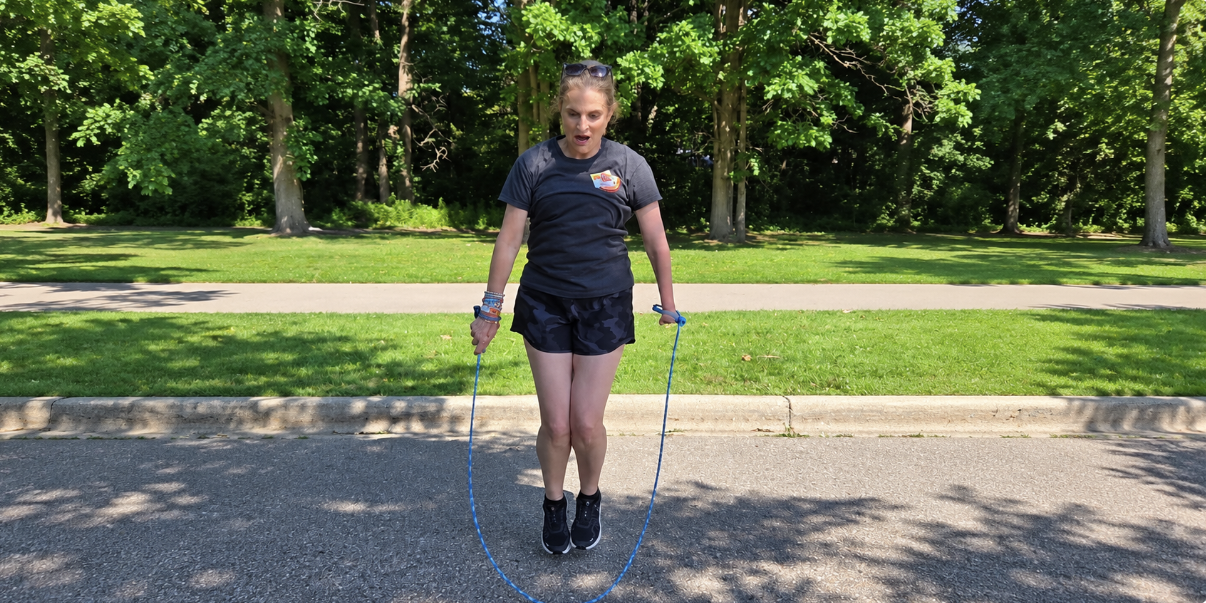
When I was a kid, I couldn’t jump rope.
I tried. My gym teacher suggested wrapping the rope around my smaller hand.
It didn’t work.
My wrist doesn’t turn in the way a traditional two-handed grip requires.
So I made a decision: jumping rope wasn’t for me.
When the other kids jumped, I stayed on the sidelines and pretended I wasn’t interested.
And then I pretty much stopped thinking about it.
For more than forty years, I didn’t try again.
Not once.
Apparently, ten-year-old me had closed the case.
This summer, at Lucky Fin Project weekend, I spotted an EazyHold band, an adaptation that connects to a jump rope so you can use it with one hand.
I was curious.
My friend Laura, an occupational therapist, handed it to me, and I tried it.
One jump became four. I kept practicing.
Eventually, I got to 100.
More than forty years after deciding I couldn’t do it.
Turns out, I just needed a different way in.
The decisions we stop questioning
I’ve been thinking less about those 100 jumps and more about the forty-plus years in between.
Jump rope didn’t prevent me from living my life.
But the conclusion I’d drawn about it started doing something else.
It started making decisions for me.
And here’s where I see the hiding now.
I wanted to jump rope.
But when I couldn’t figure out how, I stood on the sidelines and acted like I wasn’t interested.
Eventually, I’m not sure I knew the difference anymore.
“I’m not interested” became easier than “I don’t know how to do this.”
At some point, it stopped feeling like hiding at all.
Sometimes hiding isn’t only about keeping a part of ourselves from other people.
Sometimes we take ourselves out of the game.
And if we do it long enough, we may forget we ever wanted to be in it.
What happens after we hide?
That’s made me look differently at the research I’m doing on hiding at work.
I’m hearing about concerns people don’t raise, questions they don’t ask and parts of their lives they keep to themselves.
But I’m becoming more curious about what happens after that.
What does hiding stop us from doing?
Maybe we don’t contribute the idea.
Maybe we don’t put ourselves forward for the opportunity.
Maybe we don’t ask for what we need.
Maybe we don’t let someone know us well enough to really connect.
We think hiding is about what we keep from other people.
But I’m realizing it can keep things from us too: opportunities, connection, even the chance to find out what we’re capable of.
And if you’re leading people, this gets complicated.
Because holding back can look a lot like disinterest.
The person who rarely speaks in the meeting may look like they have nothing to add.
The employee who doesn’t put themselves forward may look like they don’t want the bigger assignment.
And someone who never asks for what they need?
It might just look like they’re doing fine.
My ten-year-old self looked uninterested in jumping rope.
I wasn’t.
I just couldn’t see a way for me to participate.
What holding back costs us
At work, that matters.
Because when people hold back, we may never know what they’re capable of contributing.
And sometimes, they may not know either.
An idea doesn’t get voiced. A question doesn’t get asked. Someone passes on an opportunity. A different way of doing something never gets considered.
That’s a performance cost.
But it’s also a potential cost.
For more than forty years, I would have told you I couldn’t jump rope.
I wasn’t sitting on some secret jump-rope talent.
I simply didn’t know there was another way for me to do it.
What else might we be capable of that we’ve already decided isn’t for us?
The sidelines can start to feel normal
For more than forty years, I wasn’t actively deciding not to jump rope.
I just didn’t jump rope.
That’s what gets me.
It had become so normal that I didn’t even know there was a decision left to reconsider.
And that makes me wonder:
What else have I quietly taken off the table?
Where have I stopped participating, reaching, asking or connecting because an old conclusion is still making the choice?
And if you lead people, there’s another question worth asking:
Who have I assumed isn’t interested when they may simply not see a way in?
Maybe there’s something you’ve already decided isn’t for you.
Maybe you just haven’t found your way in yet.
Thank you for being part of the UNHIDING community.
|

